Air Taxi India: Gurugram to Delhi in 7 Minutes

Air Taxi India: If you reside in Delhi, Noida, or Gurugram, you are familiar with the discomfort of “crawling” instead of driving. A commute that should take 20 minutes often stretches into hours as the city’s infrastructure struggles under the weight of millions of vehicles.
Table of Contents
But what if you could simply hop over the gridlock? The upcoming air taxi revolution in India is bringing that dream closer to reality.
What is an air taxi India?
Forget the flying cars from sci-fi movies; the future of urban mobility lies in Electric Vertical Take-off and Landing (eVTOL) aircraft. These are essentially quiet, battery-powered small planes that function like helicopters—taking off and landing vertically without needing a runway.
The Confederation of Indian Industry (CII) has already presented a plan to transform the skies over the National Capital Region (NCR) into a high-speed transit corridor.
The Magic Triangle: From Gurugram to Noida in Minutes.
The projected “Triangle Corridor” is intended to connect three key hubs: Gurugram (DLF Phase 3/Cyber Hub), Central Delhi (Connaught Place), and the forthcoming Noida International Airport in Jewar.
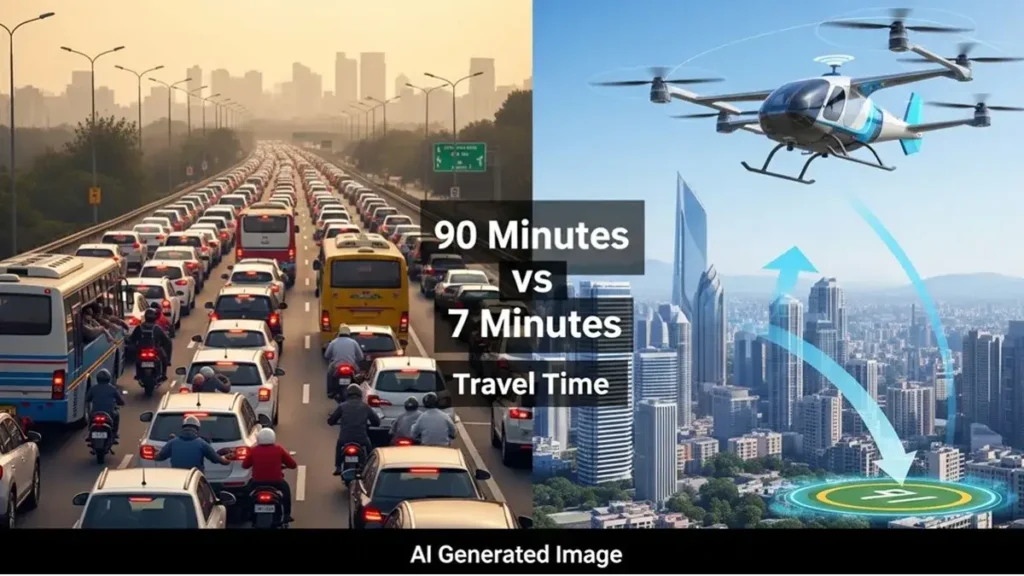
The time savings are astounding. A car drive from Gurugram to Connaught Place (CP) normally takes 60 to 90 minutes; however, an air taxi may get you there in 7 to 12 minutes. Similarly, the 2.5-hour trek from CP to Jewar Airport would shrink to a mere 18 to 20 minutes.
Who are the air taxi manufacturers in India?
India isn’t just waiting for global tech; local players are stepping up. Among the notable air taxi manufacturers in India, Nalwa Aero, a Punjab-based startup, is garnering attention by asserting that their aircraft surpasses the safety of traditional helicopters.
Their 8-rotor system ensures that even if two or three motors fail, the taxi can still land safely. Global players such as China’s EHang have already obtained flight certifications, demonstrating the readiness of the technology for prime time.
The Big Question: Air Taxi Price in India
You might be wondering if this is only for the ultra-rich. While a single aircraft can cost between ₹30 crore and ₹40 crore, the service aims to be competitive over time.
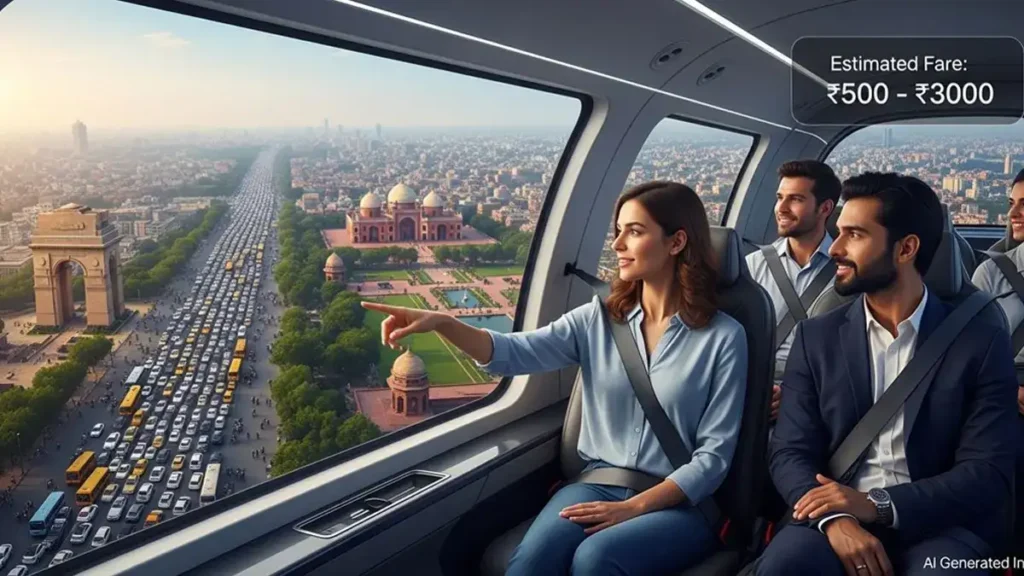
Early estimates for the air taxi price in India range from ₹500 per person for short hops to between ₹2,000 and ₹3,000 for a trip from CP to Gurugram. While this is a premium over a standard cab, the hours saved make it an attractive option for professionals and emergencies.
If we look at international benchmarks, the air taxi price in India per km could eventually settle around ₹400 to ₹500 as the technology scales, similar to rates seen in China.
Where Will They Land?
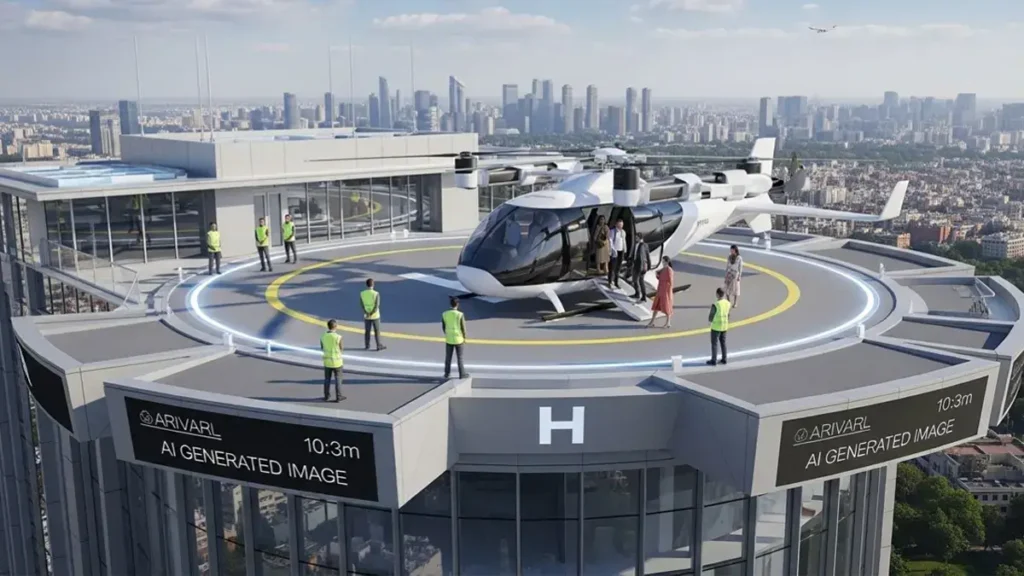
We won’t need more airports. Instead, “vertiports” will be constructed on the roofs of existing towering structures, hospitals, and shopping malls. This not only saves space in congested cities like Delhi but also generates fresh revenue for building owners.
The Challenges Ahead
However, there are still challenges to overcome. Experts point to numerous hurdles:
- Security: Getting around “no-fly zones,” such as the Lutyens’ VVIP zone and the IGI Airport, is a serious worry.
- Regulations: The DGCA would have to develop whole new guidelines for these hybrid vehicles.
- Weather: Delhi’s notorious winter fog may regularly ground these little aircraft.
- The Class Divide: Some critics argue that while the rich fly over the city, the average commuter will still be stuck navigating potholes and poor drainage on the ground.
We won’t need more airports. Instead, “vertiports” will be constructed on the roofs of existing towering structures, hospitals, and shopping malls. This not only saves space in congested cities like Delhi but also generates fresh revenue for building owners.
The Challenges Ahead
However, there are still challenges to overcome. Experts point to numerous hurdles:
- Security: Getting around “no-fly zones,” such as the Lutyens’ VVIP zone and the IGI Airport, is a serious worry.
- Regulations: The DGCA would have to develop whole new guidelines for these hybrid vehicles.
- Weather: Delhi’s notorious winter fog may regularly ground these little aircraft.
- The Class Divide: Some detractors believe that while the wealthy fly over the city, the typical commuter will be forced to navigate potholes and inadequate drainage on the ground.
Despite these challenges, the government and private sectors are optimistic. Trials for air taxi India services are expected to begin between now and 2028. Starting with medical emergencies and drone logistics, the goal is to eventually make vertical mobility a daily reality for the common man.
Therefore, the next time you find yourself at a red light in Dhaula Kuan, raise your gaze—your ride could soon be soaring above you.
Disclaimer
This material is intended for informational and exploratory purposes only. Project timeframes, price, and operating information for Air Taxi India are based on preliminary reports and plans, which may vary as legislation, technology, and government clearances progress.
Read Also:
SHE Mart mission Budget 2026 Expectations How to Apply India-AI Impact Summit 2026?